

10-Inch Dobsonian Views: Planets, Nebulae & Galaxies
What can you see with a 10-inch Dobsonian telescope?
A 10-inch Dobsonian is a serious light bucket, and that extra aperture translates into brighter views, finer detail, and the ability to pull in faint objects from dark skies. What you’ll see depends heavily on sky darkness, atmospheric steadiness, collimation, and cooling time—but even from suburban locations, a 10-inch can deliver memorable observing.
Solar system highlights
The Moon shows razor-edged crater rims, rilles, and mountain shadows that change nightly along the terminator. Jupiter often reveals multiple cloud bands, festoons, and the Great Red Spot when seeing cooperates, plus its four Galilean moons. Saturn typically displays the Cassini Division and ring shading, along with several moons (Titan is easy; more are possible in steady air). Mars can show polar caps and dark surface markings near opposition. Venus shows phases, and Mercury can too under the right conditions. Uranus and Neptune appear as tiny blue-green disks rather than point stars at higher magnifications.
Deep-sky objects you can realistically hunt down
Star clusters are a Dob’s comfort zone: the Pleiades and Double Cluster are gorgeous wide-field targets, while globulars like M13 begin to resolve into countless pinpoints. Nebulae such as the Orion Nebula (M42) show structure and “wings,” and under darker skies a 10-inch can reveal the Veil and North America Nebula with the help of a good filter. Galaxies become far more rewarding: M31 shows an extended disk, M82 looks textured, and brighter Virgo galaxies show distinct shapes—though don’t expect Hubble-style color; most detail is subtle and grayscale to the eye.
Double stars and “fine detail” targets
A 10-inch has enough resolving power to split many tight double stars when the atmosphere steadies. Color contrast pairs (like Albireo) are also striking, especially at moderate magnification.
Make the most of the aperture
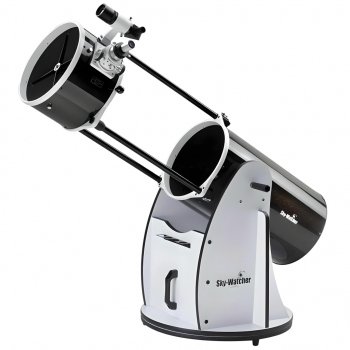
To get “10-inch” performance, let the mirror cool, collimate carefully, and use eyepieces that match your conditions. For a deeper look at what a modern 10-inch can do—especially in a storage-friendly design—see this guide to a 10-inch collapsible Dobsonian.
FAQ
Is a 10-inch Dobsonian too big to transport?
It depends on the tube design and your vehicle, but many observers manage it easily with a collapsible or truss-style model and a simple hand truck. Solid-tube versions are bulkier, yet still commonly moved in sedans and small SUVs with the back seats folded.










Leave a comment