

Collimate a 10-Inch Collapsible Dobsonian in 6 Steps
How do you collimate a 10-inch collapsible Dobsonian telescope?
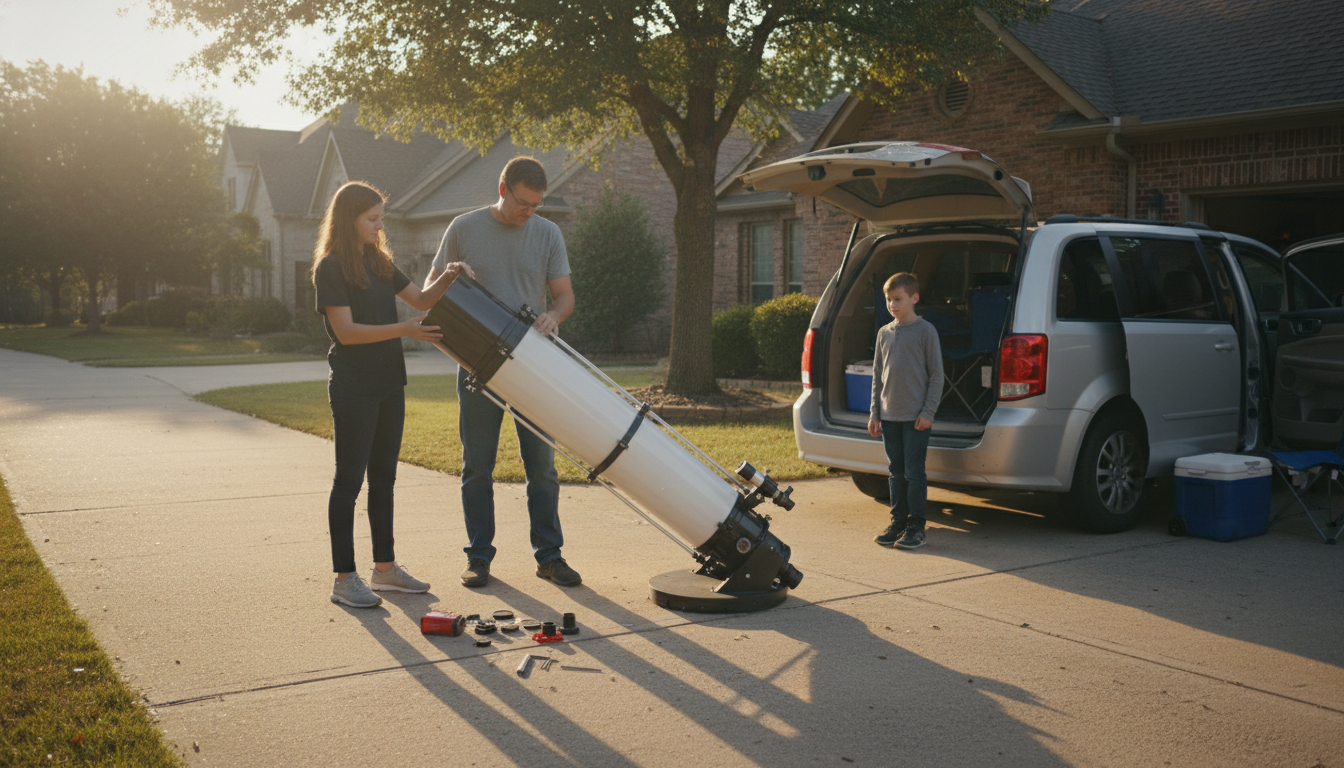
Collimating a 10-inch collapsible Dobsonian is a quick tune-up that aligns the primary mirror, secondary mirror, and focuser so stars snap into focus and planets show crisp detail. A collapsible tube adds one extra habit: always lock the trusses/struts to the same extension each session before you start, since small changes in length can shift alignment.
1) Set up the scope the same way every time
Extend the collapsible section fully, engage all locks snugly, and place the telescope on stable ground. Let the optics cool toward outdoor temperature for best results, then remove the dust cap and any eyepiece.
2) Use a simple collimation tool
A collimation cap, Cheshire/sight tube, or a well-collimated laser all work. A Cheshire/cap is forgiving and doesn’t depend on the tool being perfectly aligned; a laser is fast but must be accurate.
3) Center the secondary under the focuser
Look through the focuser with your tool and adjust the secondary mirror’s position so it appears round and centered in the focuser drawtube. This step is mostly about placement (up/down the tube and left/right) and usually doesn’t need frequent changes once set.
4) Aim the secondary at the primary center mark
Use the secondary tilt screws to move the reflection so the primary mirror’s center mark (often a donut ring) sits in the middle of your crosshairs/reticle, or so a laser dot lands precisely on the center mark.
5) Adjust the primary for final alignment
Turn the primary collimation knobs at the back of the mirror cell until the Cheshire’s bright ring and the primary center mark are concentric, or until the laser return (or Barlowed laser shadow) centers perfectly. Finish by lightly snugging any primary lock screws if your scope has them—without shifting the alignment.
6) Confirm with a quick star test
At night, defocus a moderately bright star at high power. Concentric diffraction rings on both sides of focus indicate good collimation; tweak the primary knobs only if needed.
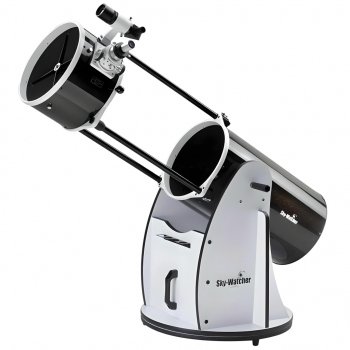
For a broader look at setup, handling, and what to expect from this size class, see the main guide: 10-inch collapsible Dobsonian telescope guide.
FAQ
How often should you collimate a Dobsonian telescope?
Check it before each observing session, especially after transport. Many observers only need minor primary-mirror tweaks most nights, with secondary adjustments much less frequently.










Leave a comment