


AI Meditation Scripts: Write, Refine, and Publish an eBook
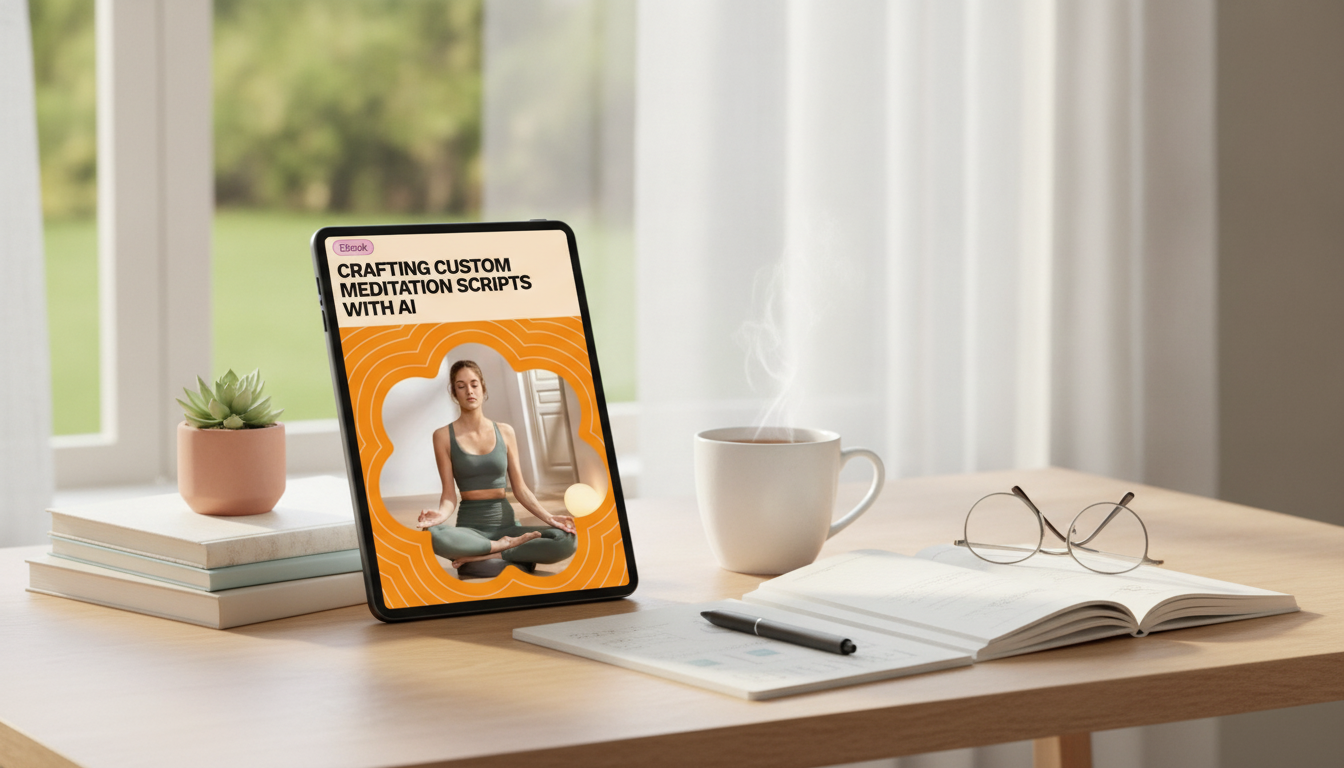
Crafting Custom Meditation Scripts with AI: From Calm Concept to Finished eBook
Custom meditation scripts work best when they match a listener’s exact needs—tone, pacing, imagery, and goals. AI can speed up drafting and provide fresh variations, while human judgment keeps the final script safe, sensitive, and true to your voice. The result can be a polished set of sessions that reads smoothly on the page and records cleanly as audio.
Mindfulness and meditation are widely studied for stress support and overall well-being, but they aren’t a cure-all. For balanced, evidence-based context, see the National Center for Complementary and Integrative Health, the American Psychological Association, and the Mayo Clinic.
What “custom” means in a meditation script
“Custom” goes beyond swapping a few adjectives. A truly tailored script is designed from the ground up around a specific outcome, a specific listener, and a consistent delivery style.
- Define the outcome: relaxation, sleep, focus, confidence, emotional regulation, or mindful movement.
- Choose a style: body scan, breath-focused, visualization, loving-kindness, gratitude, self-compassion, or a nature journey.
- Match the audience: beginners vs. experienced meditators; general wellness vs. niche goals (exam stress, pre-performance, post-work decompression).
- Set constraints: length, pace, language level, inclusivity, and whether spiritual terminology is welcome or avoided.
- Decide the delivery format: spoken audio script, read-aloud text, or self-guided journal-style meditation.
Script building blocks to decide before generating text
| Element | Options | Why it matters |
|---|---|---|
| Duration | 3–5 min, 10–15 min, 20–30 min | Affects pacing, breath cues, and depth of imagery |
| Tone | gentle, energizing, clinical-neutral, poetic | Improves fit for brand voice and listener preference |
| Structure | arrival → body → breath → theme → return | Creates consistency across a series or eBook |
| Imagery | nature, light, ocean, mountain, abstract | Enhances engagement without overstimulation |
| Language cues | invitations (“you might”), direct (“now do”), trauma-sensitive | Supports safety and autonomy |
A practical workflow: brief → draft → refine → finalize
A repeatable workflow helps your scripts feel consistent—especially if you plan to publish a series. The goal is to get a workable draft fast, then earn quality through editing.
- Start with a one-paragraph brief: include audience, goal, length, and any emotional tone to avoid (for example, “no water imagery” or “avoid ‘empty your mind’ phrasing”).
- Generate a first draft quickly: treat it like clay, not a finished product. Then do a second pass focused only on pacing and breath timing.
- Refine line-by-line: simplify sentences, reduce “busy” metaphors, and remove anything that could feel coercive or absolute.
- Read aloud for cadence: mark where you naturally speed up, where you need pauses, and where the listener may need reassurance.
- Finalize formatting: use consistent headers (Arrival, Body, Theme, Return) and optional timestamps if you’ll record audio later.
If you prefer a guided framework that turns ideas into publish-ready scripts, Crafting Custom Meditation Scripts with AI – AI for Creating a Custom Meditation Script eBook is designed to help you move from concept to a cohesive set of sessions without losing your voice in the process.
Writing inputs that reliably produce better scripts
The most useful AI drafts come from clear constraints. Specificity helps the writing sound intentional rather than “pleasant but generic.”
- Include audience details: experience level, preferred language (secular/spiritual), and common challenges (racing thoughts, restlessness).
- Specify sensory load: low-stimulation wording for anxiety; richer imagery for motivation and confidence.
- Provide a “do not include” list: triggering themes, certain body language, specific religious references, or medical claims.
- Ask for alternatives: request 3 opening options, 3 closing options, or 5 imagery variations so you can choose what fits.
- Require trauma-sensitive phrasing: invitational language, options to keep eyes open, and permission to stop at any time.
For creators recording on a phone or laptop, reliable power and clean connections matter during longer sessions. A simple, practical add-on for recording setups is the 100W USB-C to USB-C Fast Charging Cable with PD 3.0 & QC 4.0 – 5A Power, especially when multiple takes and editing sessions stretch your battery.
Polishing for safety, inclusivity, and trust
Meditation writing is intimate. Small wording choices can either support a listener’s sense of agency—or unintentionally create pressure.
- Avoid medical promises: replace “cures anxiety” with “may help you feel calmer” and keep claims general.
- Use body-neutral language: don’t assume mobility, fitness level, or specific sensations; offer options (sitting/lying/standing).
- Keep agency with the listener: “if it feels comfortable” and “you can return to the breath at any time.”
- Watch for absolutes: avoid over-suggestive transformation language; choose grounded cues the listener can actually follow.
- Add a gentle disclaimer section: clarify that meditation isn’t a substitute for professional care and encourage support when needed.
Building a cohesive eBook from multiple scripts
Common issues and quick fixes
A guided resource for turning drafts into finished scripts
For a ready-to-use system, see Crafting Custom Meditation Scripts with AI – AI for Creating a Custom Meditation Script eBook.
FAQ
How long should a beginner-friendly meditation script be?
Five to ten minutes is a comfortable starting range for many beginners. Keep pacing slow, use simple breath cues, and end with a clear, reassuring closing so the listener feels complete rather than abruptly “stopped.”
How can AI-generated meditation scripts be made more personal?
Use a detailed brief that includes the goal, audience, tone, and constraints, then request multiple openings, closings, or imagery options to choose from. Edit the final version for specific sensory details, natural pacing, and invitational language that preserves listener agency.
Is it okay to sell meditation scripts created with AI?
It can be, as long as the final script is original in its finished form and reflects thorough human review for tone, accuracy, and safety. Avoid medical claims, ensure your wording is inclusive and non-coercive, and consider being transparent about your tools if that aligns with your brand.












Leave a comment