

SCTs for Astrophotography: Strengths, Limits & Setup
Are Schmidt-Cassegrain telescopes good for astrophotography?
Schmidt-Cassegrain telescopes (SCTs) can be very good for astrophotography, but they shine most when the targets and setup match their strengths. Their long focal lengths deliver tight, detailed views of the Moon and planets, and they can also produce excellent deep-sky images with the right accessories and a solid mount.
Where SCTs perform best for imaging
For lunar and planetary astrophotography, an SCT is often an ideal tool. The long focal length makes it easier to capture fine surface detail, and techniques like high-frame-rate video stacking pair well with SCT optics. Compact size is another advantage: you can get substantial focal length in a relatively portable tube.
The main challenge: focal length and speed
Many common SCTs are around f/10, which is “slow” for deep-sky imaging. That means longer exposures and a heavier demand on tracking accuracy. The long focal length also narrows the field of view, so large nebulae and wide star fields can be harder to frame, and guiding errors are more noticeable.
Accessories that make an SCT more imaging-friendly
A focal reducer (often bringing an SCT closer to about f/6.3) can be a game-changer for deep-sky work by widening the field and reducing exposure time. For best results, pay attention to correct spacing between reducer and camera sensor. Many imagers also add an off-axis guider to keep stars tight at longer focal lengths, and careful collimation is especially important to maintain sharpness across frames.
Mount quality matters more than the tube
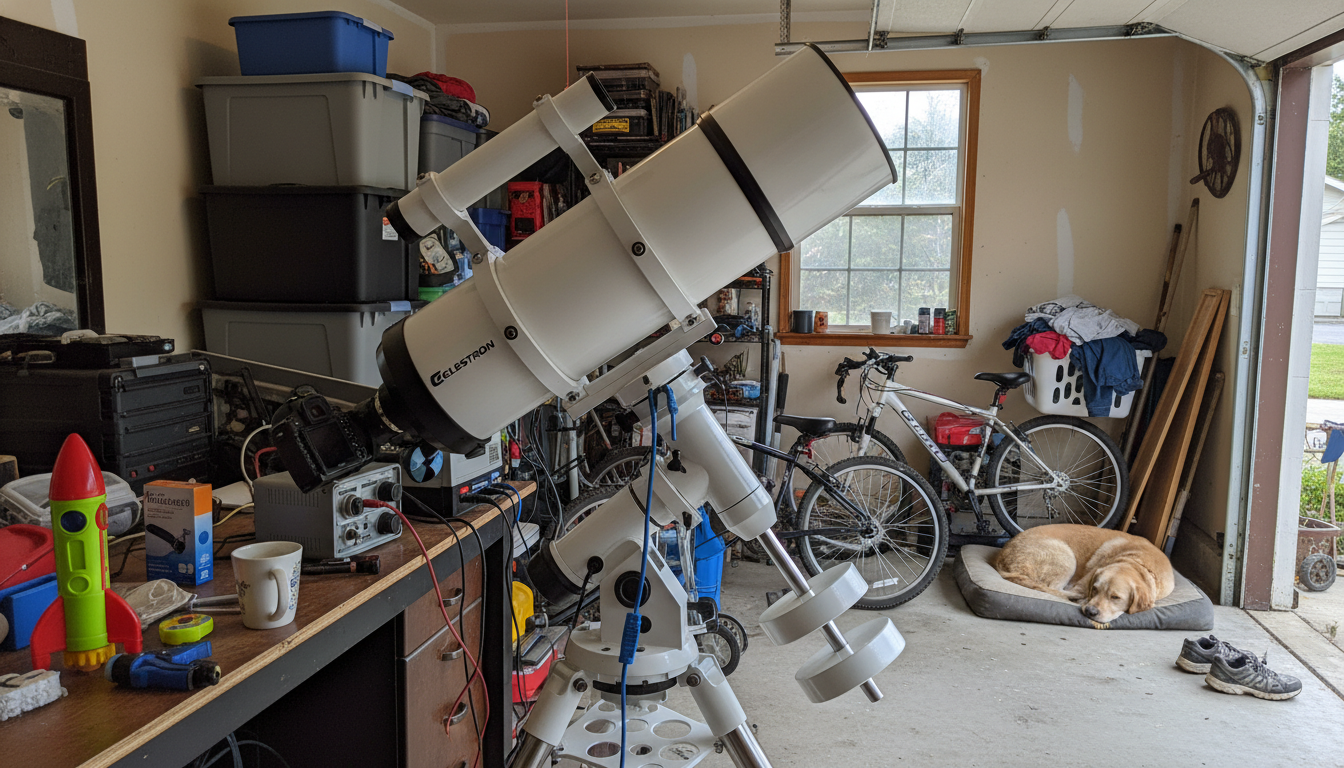
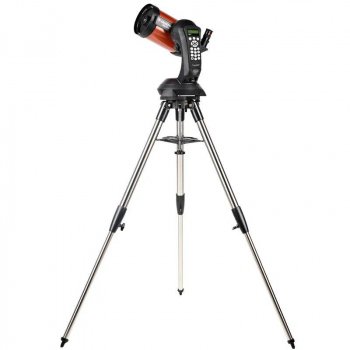
For deep-sky astrophotography, the mount is typically the deciding factor. A stable equatorial mount with accurate tracking (and guiding, when needed) will do more for image quality than upgrading the optical tube alone. If you’re considering a 125mm f/10 GoTo SCT specifically, the practical observing and setup considerations covered here are helpful: 125mm f/10 GoTo SCT StarBright XLT observing guide.
FAQ
What mount do I need for deep-sky imaging with an SCT?
A sturdy equatorial mount with sufficient payload headroom and good tracking accuracy is key. Many SCT deep-sky setups also benefit from autoguiding to keep stars round at longer focal lengths.










Leave a comment